
The AI Arbitrage Fallacy: Why Charging Less for Fast Work Destroys Your Agency

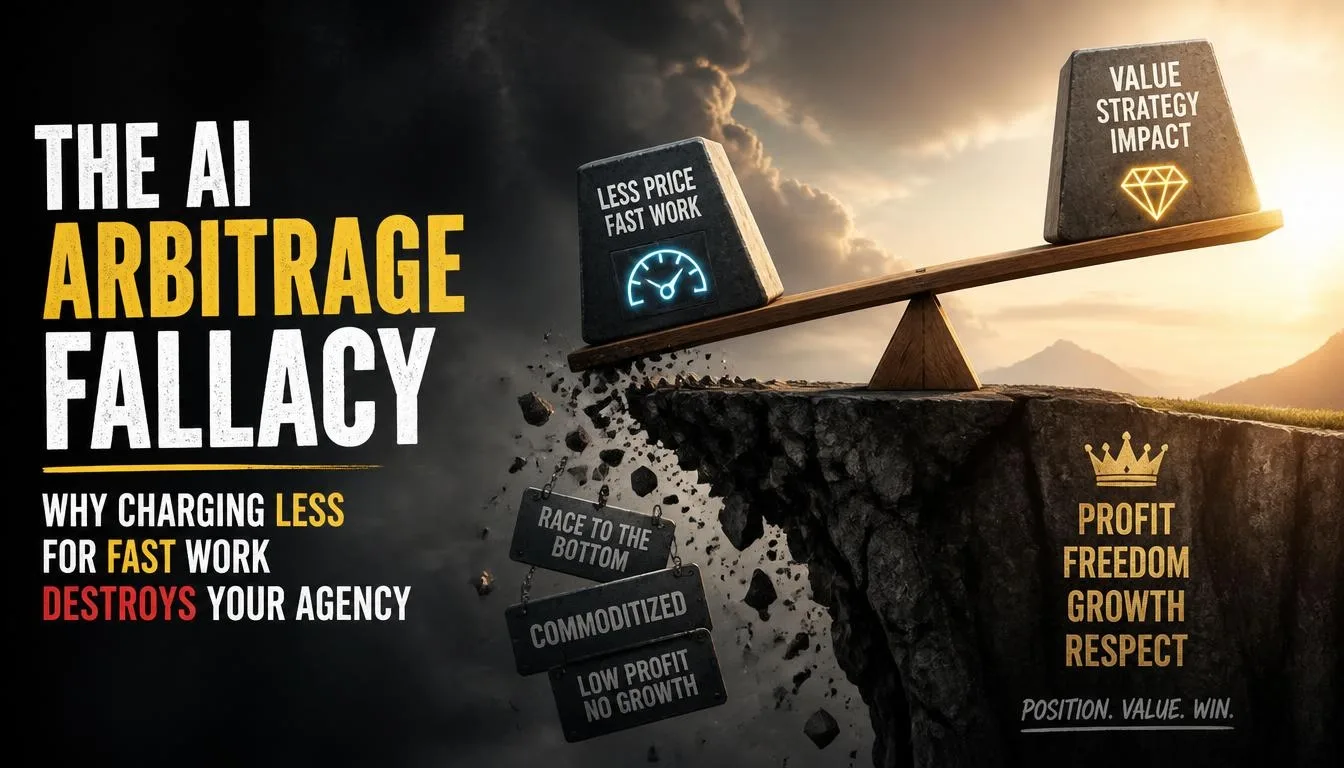
Most knowledge workers are committing economic suicide with artificial intelligence. They use advanced large language models to complete a ten-hour project in forty-five minutes, and then they panic. Terrified that the client will discover how 'easy' the work was, they discount their prices, bill for the actual time spent, or worse, race to the bottom in a desperate volume play.
This is the AI Arbitrage Fallacy. It treats generative technology as a labor-replacement tool meant to slash costs, rather than an intelligence-augmentation engine meant to elevate strategic output. If you charge by the hour, AI is your executioner. But if you decouple your compensation from time and sell elite outcomes, AI is the ultimate leverage vehicle.
We have rebuilt our agency model around a counter-intuitive thesis: Deliver AI-assisted work at human speed to command premium rates. Here is the exact blueprint for how we execute this without compromising quality, ethics, or client trust.
The Psychology of Premium Pricing: Why Speed Kills Value PerceptionIn the mind of a B2B buyer, speed and quality exist in a perpetual zero-sum tug-of-war. For decades, the market has operated on an unwritten rule: Fast, cheap, pick two. Good, fast, cheap—pick two.
When you deliver a comprehensive, meticulously researched, multi-channel marketing strategy in four hours instead of four weeks, your client's primitive business brain triggers an alarm. They think:
- 'If this took no effort, it must have no depth.'
- 'Why am I paying $10,000 for something an intern—or a machine—could spin up over lunch?'
- 'I am overpaying.'
To charge premium rates, you must manage the Perceived Friction Gap. Premium buyers do not pay for the micro-seconds it takes electrons to fire across a silicon chip; they pay for the accumulated scar tissue, pattern recognition, and strategic foresight required to prompt, curate, and refine that output into a bulletproof business asset.
The Illusion of Effort vs. The Reality of ExpertiseImagine hiring an elite litigator. She reviews a complex contract in twelve minutes, finds a lethal loophole that saves your company millions, and sends an invoice for $15,000. You do not complain that she only spent twelve minutes on it. You pay happily because you understand you are paying for the twenty years she spent learning which twelve minutes to look at.
AI-assisted knowledge work is no different. The prompt engineering, the contextual grounding, the hallucination auditing, and the structural refinement are invisible labors. If you hand raw, unedited LLM output to a client, you are selling raw ingredients. If you run that output through a gauntlet of rigorous human critique, domain expertise, and bespoke styling—while maintaining a respectful, deliberate delivery cadence—you are serving a five-star meal.
The Operational Framework: Human Speed, AI LeverageDelivering at 'human speed' does not mean intentionally sitting on your hands or lying to clients about your workflow. It means repurposing the time reclaimed by AI away from automated grunt work and reinvesting it into high-leverage strategic depth.
Phase 1: Zero-Shot to Context-Rich Prompt Engineering (10% of time)Amateurs use AI to write the final draft. Experts use AI to build the scaffolding, stress-test hypotheses, and generate contrarian viewpoints. When we tackle a complex client deliverable—say, an enterprise brand architecture playbook—we do not ask ChatGPT to 'write a brand guide.'
Instead, we feed the model proprietary customer interviews, financial statements, competitor teardowns, and brand archetypes. We use multi-agent simulations to model how the target demographic will react to specific messaging. This phase requires intense human orchestration. It is not fast; it is hyper-focused cognitive load.
Phase 2: The Ruthless Editing and Hallucination Audit (40% of time)Generative AI is a pathological liar with a silver tongue. It hallucinates statistics, misinterprets industry nuances, and defaults to platitudes ('In today's fast-paced digital landscape...').
The premium differentiator is not generation; it is curation and validation. We spend the bulk of our AI-assisted workflow cross-referencing claims, injecting real-world proprietary data, removing systemic AI linguistic markers, and ensuring the voice matches the client’s exact cultural frequency. This is bespoke tailoring.
Phase 3: Strategic Packaging and Delivery Cadence (50% of time)This is where the magic happens. Because AI handled the heavy lifting of synthesis and structural drafting, your brain is entirely unburdened by fatigue. You are not exhausted from staring at a blinking cursor trying to figure out how to phrase an executive summary.
You use that recovered cognitive surplus to:
- Design custom visual data visualizations that illuminate key insights.
- Record a 15-minute Loom video walking the CEO through the strategic implications of the document.
- Anticipate objections the CFO might raise and preemptively build an appendix addressing them.
By pacing your delivery—returning the work not in two hours, but in a polished, beautifully packaged format within a standard 3-to-5 day window—you respect the client's internal operational rhythm while blowing past their expectations on depth.
Case Study: Transitioning from Hourly Execution to Outcome-Based RetainersConsider a boutique copywriting and positioning agency we consulted last year. They were billing $150/hour for sales pages, email sequences, and whitepapers. As they integrated advanced AI workflows, their output velocity quadrupled. Suddenly, a $3,000 project that took 20 hours now took 5.
Panic set in. The founder felt like a fraud billing 5 hours of work for a $3,000 deliverable. They considered lowering their project fees to match the new labor reality.
We intervened and executed a radical pivot:
- Eliminated the Hourly Model: We banned hourly billing across the board. Every service was restructured into flat-fee, outcome-based tiers.
- Upgraded the Deliverable: Instead of selling 'a 5-email onboarding sequence,' they sold 'The Frictionless Customer Activation System,' which included the emails, an implementation roadmap, a CRM tagging matrix, and a conversion optimization audit.
- Leveraged AI for Depth, Not Speed: The AI allowed them to test 14 different psychological angles per email instead of 2. They chose the absolute best angle, refined it manually, and delivered a work of art.
The Result: Their project minimum jumped from $3,000 to $12,000. Their client satisfaction scores skyrocketed because the strategic comprehensiveness of the output was orders of magnitude higher than before. Their actual time spent per project dropped, but their profit margins exploded.
The Ethical Imperative: Transparency vs. TMIA common point of friction for ethical professionals is honesty: Should I tell my clients I use AI?
The answer depends on how you frame your value proposition. If you bill yourself as a human typewriter whose primary skill is pressing keys on a keyboard in a specific sequence, then yes, using AI without disclosure is deceptive. But if you bill yourself as a strategic consultant, a creative director, or a fractional executive, your clients do not care what tools you use to draft documents—they care that the strategy works.
Do not sell 'AI services.' Sell results backed by modern operational leverage.
When clients ask about our AI usage, our response is clear, confident, and unapologetic: 'We leverage proprietary machine intelligence models to accelerate our research, synthesis, and drafting phases. This frees up our senior strategists to spend 80% of their time on custom architecture, validation, and bespoke execution for your specific business.'
Clients love this. It signals that you are modern, efficient, and relentlessly focused on quality.
Summary: The Rules of AI-Era Premium PositioningIf you want to escape the commoditization trap and command fees that reflect true strategic value, memorize these four rules:
- Never price your time; price your impact. AI breaks the hour-to-value correlation forever. Do not let it drag your pricing down with it.
- Reinvest time into depth. Use the hours saved by AI to add layers of strategy, design, and foresight that algorithms cannot replicate.
- Maintain a deliberate cadence. Deliver work at a pace that matches high-end executive expectations. Fast is good; thoughtful and thorough is premium.
- Curate ruthlessly. Raw AI output is a commodity. Human-refined, context-grounded, beautifully packaged intelligence is a luxury asset.
The future does not belong to the human who types the fastest. It belongs to the expert who orchestrates intelligence the smartest.
The AI Arbitrage Fallacy: Why Charging Less for Fast Work Destroys Your Agency
Stop discounting fast AI work. Discover how to leverage AI for high-end strategy and command premium agency pricing instead of racing to the bottom.