
The High-Margin Blueprint: How to Create and Sell Email Templates That Actually Convert

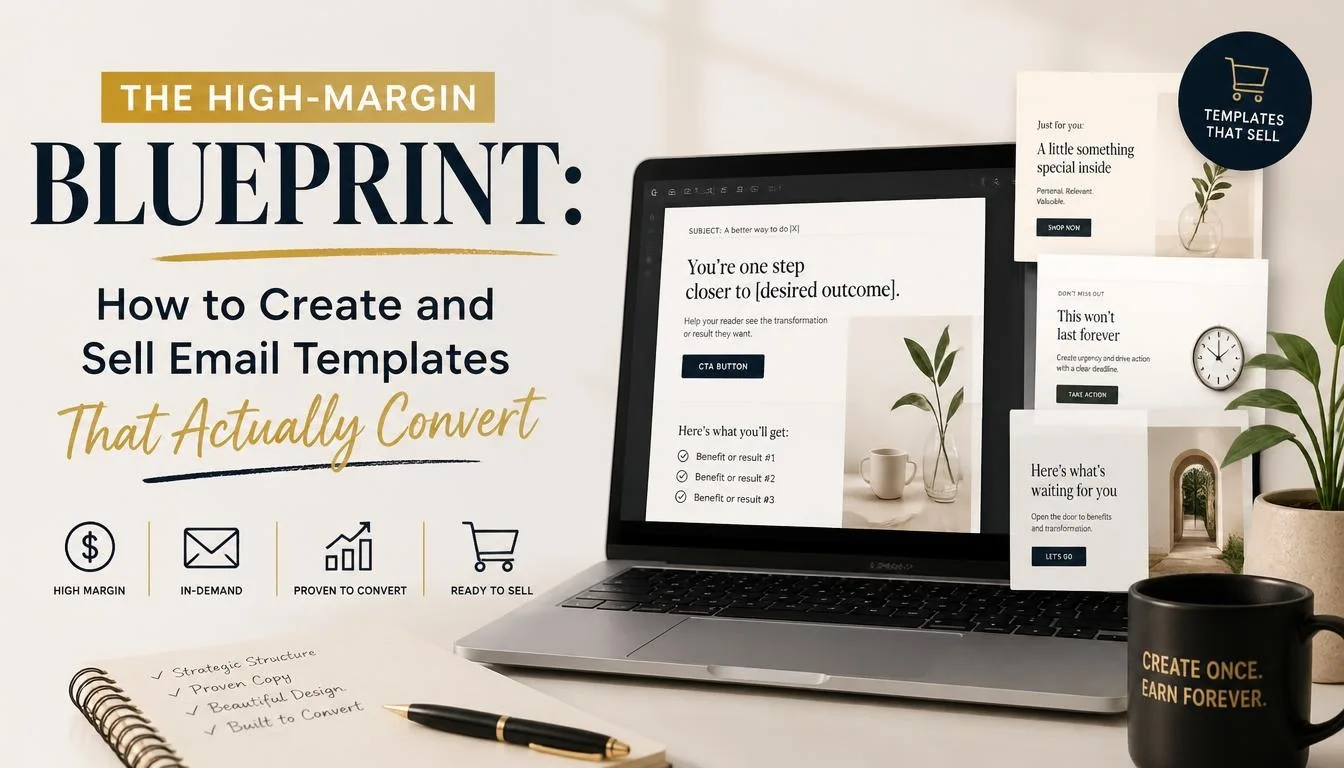
Most creators approach digital products backward. They spend six months building a sprawling online course with a 4% completion rate, only to realize the market wants speed, not a second-semester college syllabus. If you want to monetize your expertise without getting bogged down in curriculum design, look at email templates and swipe files.
An email template or swipe file is the ultimate high-leverage digital asset. It solves an immediate, painful business problem: the blank page syndrome. When a B2B SaaS founder needs to write a cold outreach sequence or a DTC marketer needs a retention campaign for Black Friday, they don’t want theory. They want plug-and-play architecture.
Over the past decade of running email marketing operations for venture-backed startups and scaling my own digital product catalog, I’ve watched generic swipe files bomb while hyper-specific, battle-tested templates generate six figures in passive revenue. Here is the exact blueprint for creating, pricing, and scaling an email template business that stands out in a crowded market.
Phase 1: Sourcing and Validating High-Value AnglesThe biggest mistake creators make is building templates based on what they think people should write, rather than what the market is already paying to solve. To create a swipe file that sells, your information gain must come from real-world testing. You cannot curate this from other blog posts; it must stem from actual revenue-generating campaigns.
Mine Your Own Data FirstLook back through your sent folder or your clients' historical campaigns. Identify the emails that outperformed the baseline. Ask yourself:
- What was the hook? Did it rely on a contrarian opinion, a surprising data point, or a direct question?
- How did the body transition from the hook to the pitch?
- What was the psychological trigger—loss aversion, social proof, urgency, or curiosity?
If you don’t have your own data, don’t fake it. Partner with operators who do, or conduct deep-dive teardowns of market leaders. Frame your templates not as abstract creative writing exercises, but as historical blueprints of campaigns that cleared specific revenue hurdles.
Find the Micro-Niche Pain PointBroad products like 'The Ultimate Cold Email Swipe File' are dead. The market is saturated with generic trash. Instead, drill down into high-intent micro-niche problems. For example:
- Cold email sequences for boutique SEO agencies targeting Series A fintech startups.
- Post-purchase win-back flows for Shopify stores selling perishable food items.
- Re-engagement campaigns for churned SaaS enterprise trial users.
The more specific the context, the higher the perceived value. A buyer will gladly pay $97 for a template engineered specifically for their exact business model because it saves them days of trial and error.
Phase 2: Structuring the Template for Maximum UsabilityA good email template doesn't just give the user something to copy and paste; it teaches them why the framework works so they can adapt it. If a customer pastes your template, gets zero results, and doesn't understand why, they will refund and leave a bad review.
The Anatomy of a High-Converting Template AssetEvery single template in your swipe file should follow a standardized architecture:
- Context & Constraints: When should this email be used? Who is the target audience? What is the ideal sending time or trigger event?
- The Anatomy Breakdown: A bulleted list explaining the psychology behind each section (Subject Line, Hook, Body, Call-to-Action).
- The Fill-in-the-Blank Copy: Clearly marked bracketed variables like
[Insert Specific Industry Pain Point here]. - The Real-World Example: The exact, unedited version of the email as it was sent in the wild, including the metrics it achieved (e.g., 48% open rate, 12% click-to-open rate).
Deliverability and user experience dictate your product format. Do not just dump a PDF of text into a Gumroad download link. PDFs are notoriously difficult to copy from on mobile devices and destroy formatting.
Instead, leverage Notion or structured Google Drive folders. Notion acts as an interactive command center where users can duplicate your swipe database into their own workspace, filter by objective (e.g., Sales, Retention, Onboarding), and tag by industry.
Phase 3: Pricing Strategy and PackagingCreators chronically underprice digital assets. They treat a $200-value swipe file like a cup of coffee because digital goods cost nothing to replicate. This is a fatal error in positioning.
Tiering Your OfferStructure your product suite into three distinct tiers to capture different segments of your audience:
- The Starter Swipe (Low Ticket - $27 to $47): A focused collection of 10 to 20 templates for a single use case (e.g., The Cold Outreach Kit). Great for impulse buys and top-of-funnel acquisition.
- The Master System (Mid Ticket - $97 to $197): A comprehensive library of 50+ templates covering an entire customer lifecycle (welcome series, cart abandonment, flash sales, win-back). This should include video loom breakdowns explaining how to customize each piece.
- The Implementation Suite (High Ticket - $497+): The templates plus a live teardown session, custom Loom reviews of the buyer's implementation, or plug-and-play integrations for specific email service providers (Klaviyo, ConvertKit, ActiveCampaign).
Your sales page copy must anchor the price against the alternative. If a freelance copywriter charges $300 for a single email sequence, or if an agency charges $2,500 a month to write retention flows, a $147 template library that lets a founder write their own emails in 20 minutes is not an expense—it is an immediate, high-ROI capital allocation.
Phase 4: Distribution and Marketing EnginesBuilding the product is 20% of the battle. Distribution is the other 80%. If you rely solely on a marketplace like Gumroad or Etsy, you will drown in a sea of algorithmic competition. You need a deliberate acquisition engine.
Leverage Build-in-Public Content MarketingDocument the creation process on LinkedIn, X (Twitter), or YouTube. Share teardowns of famous emails for free. Break down why a specific brand’s subject line worked, show the data, and then drop a teaser for your paid swipe file at the end of the thread.
Content that demonstrates deep domain expertise acts as a natural magnet for high-intent buyers. When you give away 80% of your framework for free in public, people naturally assume the paid 20% is worth 10x the price.
Build an Affiliate ArmyGive other creators and micro-influencers in your niche a 40% to 50% affiliate split through platforms like Lemon Squeezy or Gumroad. Email template products have near-zero marginal cost, meaning high affiliate splits cost you nothing out of pocket while giving you access to pre-built audiences.
The Long-Term Play: Maintenance and UpdatesDigital products shouldn't be 'set and forget' if you want a compounding asset. Email marketing dynamics change. Spam filters evolve, iOS privacy features shift metrics, and consumer attention spans shrink.
Position your product as a living asset. Charge an annual subscription or release quarterly updates (e.g., 'The Q3 2026 AI-Optimized Cold Email Swipe File'). This allows you to run recurring promotional campaigns to your list, introducing new variants, adjusting for shifting platform algorithms, and continuously driving fresh revenue from an established digital asset.
The High-Margin Blueprint: How to Create and Sell Email Templates That Actually Convert
Learn how to create, price, and sell high-converting email templates and swipe files. Stop building courses and start selling speed today.