
The AI-Assisted Freelance Portfolio: How to Showcase GenAI Work Ethically Without Burning Client Trust

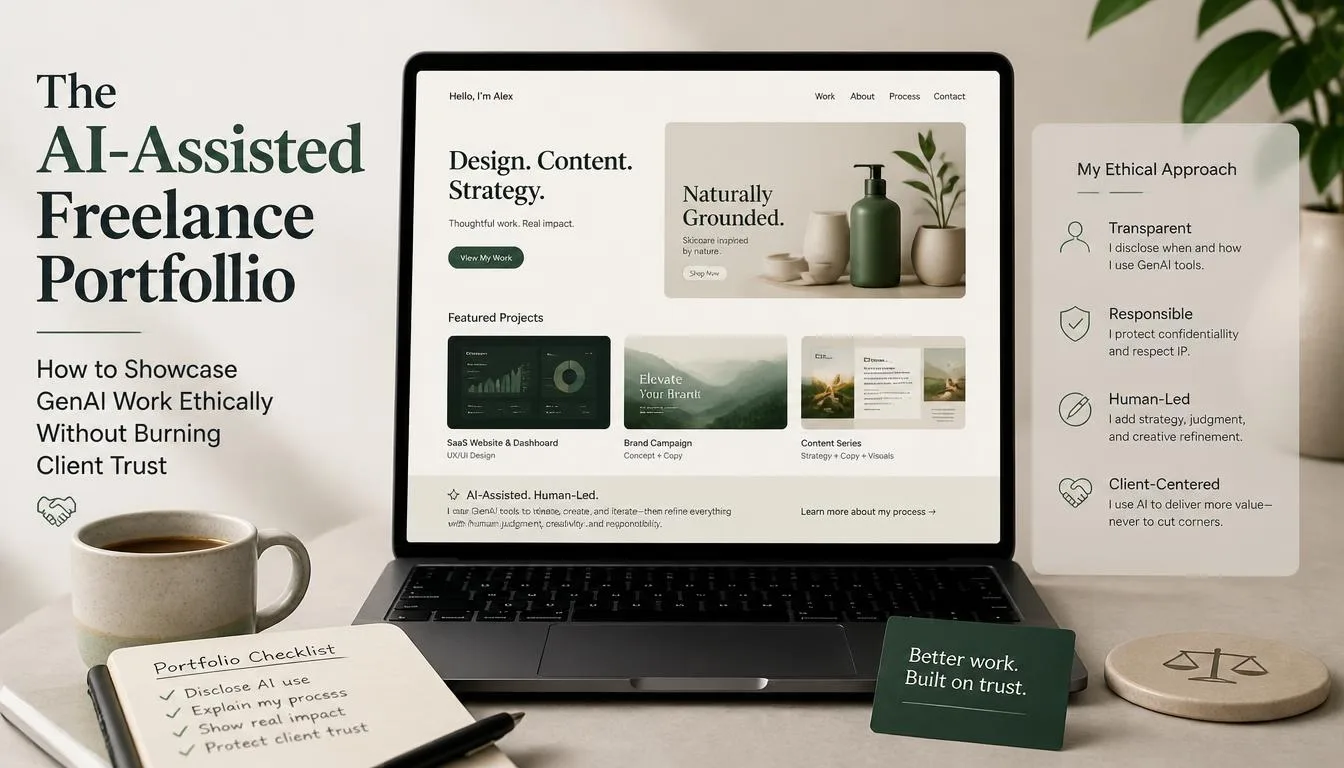
Generative AI has fundamentally fractured the traditional freelance portfolio. On one side, platforms are flooded with generic, synthetic case studies built on prompts rather than professional problem-solving. On the other, clients are growing aggressively protective of their intellectual property, viewing any hint of automated shortcuts as a breach of contract. If you are a modern freelancer, your portfolio is your primary trust-engine. Treating AI as an invisible co-creator or—worse—passing off unedited LLM output as your own creative labor is an express ticket to career obsolescence.
To survive and thrive in the current landscape, you must master the art of ethical transparency. Building an AI-assisted portfolio isn't about hiding your usage; it's about weaponizing your strategic orchestration of AI tools as proof of high-level expertise.
The New Portfolio Economy: Skill Over ExecutionFor decades, the freelance economy rewarded execution speed. The writer who could churn out 5,000 words a day or the designer who could quickly mock up variations held a distinct market advantage. Generative AI has commoditized raw execution. Today, execution is cheap, fast, and ubiquitous.
Consequently, the value has shifted entirely to curation, taste, problem formulation, and quality control. When a prospective client evaluates your portfolio in 2026, they aren’t looking to see if you can write a prompt. They want to see how you directed an AI system to solve a complex, messy human problem under tight constraints.
If your portfolio only displays polished final assets without context, you are competing directly with automated agents—and you will lose on price every single time. Your portfolio must document the architecture of your workflow, proving that human judgment drove the final outcome.
Defining the Ethical Boundaries of AI Portfolio PiecesBefore publishing a single project, you must establish strict ethical guardrails regarding what constitutes legitimate AI assistance versus outright misrepresentation. Misrepresenting synthetic output as human-crafted work destroys your professional reputation the moment a sharp-eyed client uncovers the discrepancy.
The Three Tiers of AI Portfolio Integration- Tier 1: Foundational Ideation & Research (Fully Ethical to Showcase). Using AI to synthesize market data, generate outlines, or brainstorm alternative concepts. The human does all the heavy lifting of execution and refinement.
- Tier 2: Accelerated Production & Drafting (Conditional Showcase). Using AI to generate rough drafts, wireframes, or code snippets that are subsequently subjected to heavy human editing, fact-checking, and styling. Requires clear disclosure.
- Tier 3: Unedited Generative Output (Never Portfolio-Worthy). Copy-pasting text directly from an LLM, or publishing raw Midjourney/Stable Diffusion outputs without transformative human design input. This is not portfolio work; it is digital spam.
When you display Tier 2 work, your ethical obligation is straightforward: disclose the toolchain. Think of it like a photography portfolio where the artist notes that a photo was shot on film versus digitally rendered. It contextualizes the craft.
Step-by-Step: Building an Ethical, High-Converting AI-Assisted PortfolioTo build a portfolio that commands premium rates while leveraging AI, you must systematically restructure how you present your case studies. Move away from simply showing the 'After' picture and lean into the methodology.
1. Pivot from 'Showcase' to 'Process Breakdown'Traditional portfolios show the finished design or article. AI-era portfolios must showcase the Prompt-to-Product Pipeline. For every major project, include a dedicated section that details:
- The initial human hypothesis or creative brief.
- The specific AI models or custom agents utilized during the research or drafting phase.
- The human intervention points—where did you reject the AI output, rewrite the code, or pivot the visual direction?
- The final human polish that elevated the work from good to exceptional.
The biggest hurdle freelancers face is that their best AI-assisted work is often bound by strict Non-Disclosure Agreements (NDAs). Clients rarely want competitors knowing they utilized experimental AI workflows, fearing regulatory scrutiny or brand dilution.
The ethical workaround is the De-identified Speculative Case Study. If you used an innovative fine-tuned LLM workflow to optimize a SaaS company's onboarding emails under NDA, rebuild the case study using a fictional company in the same vertical. Explicitly state in the portfolio: 'Based on an actual production workflow deployed for an enterprise SaaS client under NDA.' This demonstrates your capability without violating legal bounds or betraying trust.
3. Explicitly Publish Your AI Disclosure StatementTransparency builds instant authority. Create a permanent 'AI Ethics & Workflow' page on your portfolio site, or add a standardized disclosure badge to individual projects. A clear statement sets you apart from deceptive competitors:
"I believe generative AI is a powerful leverage tool, not a replacement for human expertise. In my work, AI is utilized for rapid prototyping, data synthesis, and preliminary drafting. Every final deliverable undergoes rigorous human editing, fact-checking, and strategic refinement to ensure absolute originality and quality."
Case Study Comparison: The Wrong Way vs. The Right WayTo visualize how this impacts conversion rates, consider two different freelance copywriters applying for a high-end fintech writing contract.
The Wrong Way (The Lazy Synthesizer)This freelancer drops three articles into their portfolio that were generated entirely via an LLM prompt. The text sounds remarkably similar to thousands of other blogs online—fluent, structurally sound, but completely devoid of proprietary insights, original data points, or distinct brand voice. When the client runs the text through an internal audit or asks deep architectural questions during the interview, the freelancer collapses.
The Right Way (The AI Orchestrator)This freelancer presents a case study titled: 'Scaling Financial Education Content by 400% Using Custom-Trained LLM Workflows.' The case study includes:
- A breakdown of how they built a custom retrieval-augmented generation (RAG) pipeline to keep financial compliance data accurate.
- Screenshots of the prompt iteration logs showing how they refined the tone away from generic corporate jargon.
- A clear explanation of the 3-stage human editing process used to inject proprietary interviews and unique thought leadership.
- Measurable business results: organic traffic growth and zero compliance flags.
Which freelancer do you think commands a $150/hour rate versus a $15/hour rate? The orchestrator wins every time because they sell systematic problem-solving rather than raw text generation.
The Pros and Cons of Disclosing AI AssistanceTransparency comes with distinct strategic trade-offs that you must manage deliberately.
The ProsThe Cons
- Trust Calibration: High-end clients appreciate honesty and are actively looking for freelancers who know how to safely integrate AI without risking corporate security or brand reputation.
- Differentiation: You stand out immediately in a sea of low-effort generalists trying to pass off raw synthetic outputs as their own.
- Legal and Contractual Safety: You eliminate the risk of mid-project termination or liability claims resulting from undisclosed synthetic IP.
Future-Proofing Your Freelance Business
- Luddite Resistance: A small percentage of traditional clients may harbor knee-jerk biases against any mention of AI, requiring you to educate them on your risk-mitigation strategies.
- Higher Portfolio Maintenance: Writing detailed process breakdowns takes significantly more time than simply slapping up a JPEG or a link.
The freelance market is undergoing a brutal sorting mechanism. The middle class of execution-based freelancers is rapidly evaporating, squeezed between enterprise-grade AI tools on one side and ultra-cheap global labor on the other. The only tier that remains safe—and extraordinarily lucrative—is the Strategic Orchestrator.
By building a freelance portfolio that champions ethical AI integration, rigorous human oversight, and absolute transparency, you stop hiding your tools and start showcasing your mastery. You aren't just selling what you made; you are selling the sophisticated, bulletproof system you used to make it. That is the gold standard of modern freelance positioning.
The AI-Assisted Freelance Portfolio: How to Showcase GenAI Work Ethically Without Burning Client Trust
Learn how to build a high-converting freelance portfolio featuring AI-assisted work ethically. Master client disclosure, process breakdowns, and trust.