
Architecting the Autonomous Customer Acquisition Funnel with AI

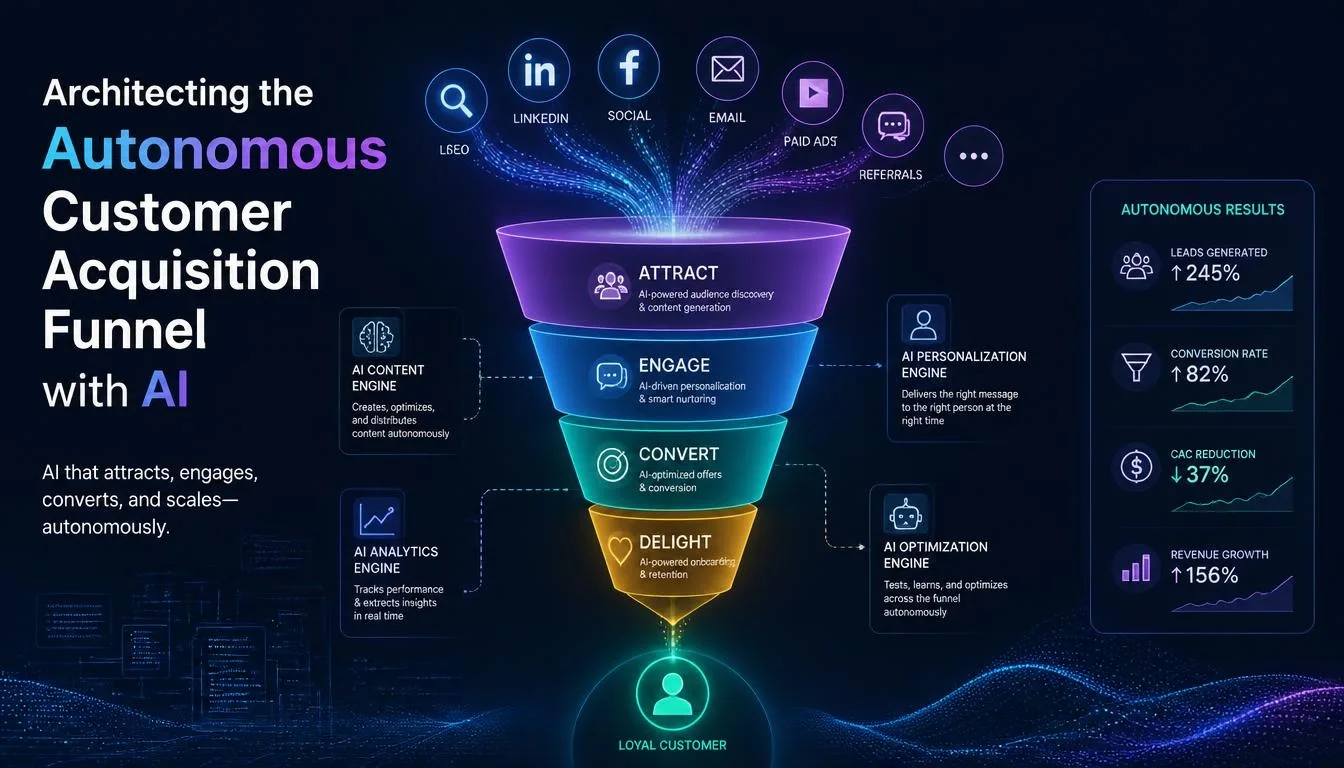
For the past decade, digital marketing has operated on a lie: that more human labor equals better conversion rates. Growth teams have scaled by hiring armies of copywriters, media buyers, and SDRs, strapping them into fragile Zapier mazes, and hoping the leaky bucket fills up faster than it drains. That playbook is officially dead.
Implementing artificial intelligence into your customer acquisition funnel is no longer about generating blog posts with ChatGPT or running automated email sequences. It requires building a self-optimizing, closed-loop ecosystem where machine learning models handle everything from prospecting to qualification, creative generation, and conversion.
Having re-engineered customer acquisition engines for over two dozen B2B and DTC brands, I can tell you this: the companies dominating their markets in 2026 are not using AI to write emails. They are using AI to eradicate human latency from the revenue pipeline entirely.
Deconstructing the 4-Stage Autonomous Acquisition EngineTo automate your funnel end-to-end, you must dismantle the traditional top-middle-bottom structure and replace it with an intelligent, continuous loop. Here is the exact architecture we deploy to turn cold traffic into closed revenue with near-zero human intervention.
Stage 1: Intent-Driven Hyper-Personalized ProspectingTraditional lead lists are obsolete. Buying a database of 10,000 ICP (Ideal Customer Profile) contacts and blasting them with cold outreach is a fast track to spam folders and burned domains. Autonomous prospecting relies on real-time signal detection.
- Signal Monitoring: Deploy LLM-powered scraping agents that monitor job board changes, funding announcements, tech-stack modifications (via tools like BuiltWith), and C-suite executive shifts.
- Graph Databases: Feed these real-time signals into a vector database linked to your CRM.
- Dynamic ICP Matching: Instead of static filters, let an embedding model evaluate whether a company's current digital footprint matches the latent characteristics of your best historical customers.
Once a high-intent account is identified, the system generates a custom outreach asset—not a template with merged first names, but a fully contextualized video or text asset built by synthesizing the prospect's latest earnings call or LinkedIn activity.
Stage 2: Generative Multi-Channel Ad and Content EnginesPaid media optimization used to require a media buyer staring at dashboards, manually swapping out creative variants. Today, generative AI handles the entire creative lifecycle: ideation, production, testing, and scaling.
- Automated Hook Generation: Use fine-tuned models trained on your top-performing historical ad copy to output 100 new hook variations weekly.
- Dynamic Asset Assembly: Connect your LLM to generative video and image APIs (like Midjourney or Runway) to automatically render localized ad variants for different audience segments.
- Autonomous Bid and Budget Allocation: Implement reinforcement learning agents via API directly into ad platforms like Meta and Google Ads. These agents adjust bids and kill underperforming ad sets within minutes, far outpacing human reaction times.
When a prospect clicks your ad or visits your site, the conversion bottleneck used to be the intake form. Static forms kill conversion rates. We replace them with contextual, voice-enabled and text-based conversational agents.
Unlike rule-based chatbots of the past that frustrated users with rigid decision trees, modern Large Action Models (LAMs) understand nuance, industry jargon, and buying objections. When a visitor lands on your pricing page, the AI agent initiates a bespoke interaction:
- It analyzes the visitor's IP and referral path to deduce company size and intent.
- It answers complex technical questions by querying your internal documentation and product knowledge base in real-time.
- It dynamically qualifies the lead against BANT (Budget, Authority, Need, Timeline) criteria through natural dialogue.
If the prospect is qualified, the AI does not just drop a Calendly link. It checks your account executive's calendar, negotiates a time that works for both parties, sends the calendar invite, and populates the CRM with a detailed dossier of the conversation.
Stage 4: Autonomous Conversion and Closing LoopsFor high-ticket B2B sales, the human closer still holds value, but the administrative weight surrounding them is entirely automated. For low-to-mid ticket offers, the entire checkout process is guided by behavioral personalization.
Pricing pages, checkout flows, and up-sell sequences must be dynamic. If the AI detects hesitation (e.g., erratic cursor movement, prolonged hovering over the FAQ section, or attempts to close the tab), it triggers a micro-incentive or surfaces a targeted case study directly addressing the detected objection.
The Tech Stack Blueprint: What You Need to Build This TodayBuilding an autonomous funnel requires moving away from monolithic SaaS platforms and embracing a modular, API-first architecture. Below is the blueprint we use in production:
- Data Layer: Snowflake or Pinecone for vector embeddings and unified customer data.
- Orchestration Layer: Make.com or custom Python scripts running on AWS Lambda, orchestrating API calls between agents.
- Intelligence Layer: OpenAI (GPT-4o) and Anthropic (Claude 3.5 Sonnet) for reasoning, combined with open-source models (Llama 3) hosted via Groq for high-speed classification tasks.
- Execution Layer: Clay for outbound data enrichment, Vapi or Retell AI for voice agents, and HubSpot or Salesforce as the system of record.
Automation at scale magnifies errors just as efficiently as it magnifies success. If you deploy an unvetted AI acquisition funnel, you risk brand destruction overnight. Keep these counter-measures in mind:
1. Hallucination and Brand DriftLLMs are notoriously creative when they lack data. In an acquisition funnel, a hallucinated product feature or pricing promise can lead to legal liability or churned customers. The Fix: Implement strict Retrieval-Augmented Generation (RAG) frameworks with zero temperature settings for customer-facing touchpoints. Never let an outbound model speak without grounding its output in verified enterprise knowledge bases.
2. Deliverability CollapseScaling automated email outbound without rigorous infrastructure management will instantly destroy your domain reputation. The Fix: Use distributed mailbox architecture, AI-driven warmup tools, and real-time inbox placement monitoring. If bounce rates tick above 1.5%, an automated kill-switch must pause the campaign.
3. The Empathy GapOver-automation can make a brand feel sterile and robotic, driving prospects away. The Fix: Design your AI agents to acknowledge emotion and complexity. Train them to recognize when a human touch is required and smoothly transition the conversation to a human team member with full context.
Measuring Success: The Metrics That MatterForget vanity metrics like cost-per-click or open rates. When your funnel is fully autonomous, your dashboard should track efficiency at the unit-economics level:
- CAC-to-LTV Ratio (Real-Time): Calculated continuously based on live ad spend and cohort retention data.
- Time-to-Conversion: The duration between initial signal detection and closed-won status. AI should compress this metric by at least 60%.
- Human Intervention Rate (HIR): The percentage of leads that require human assistance before closing. Your goal is to drive this down toward zero for SMB segments and optimize it for enterprise deals.
Automating your customer acquisition funnel with AI is no longer an experimental growth hack; it is the baseline requirement for operational survival in a hyper-competitive market. The companies winning today are not out-spending their rivals; they are out-learning them, executing thousands of micro-experiments an hour while their competitors wait for Monday morning standups. Build the loop, protect your brand parameters, and let the machines drive revenue.
Architecting the Autonomous Customer Acquisition Funnel with AI
Discover how to build a self-optimizing autonomous customer acquisition funnel using AI. Expert architecture, tech stacks, and scaling strategies.