
The Zero-Touch Digital Product Delivery Blueprint: Architecture, Stack, and Edge Cases

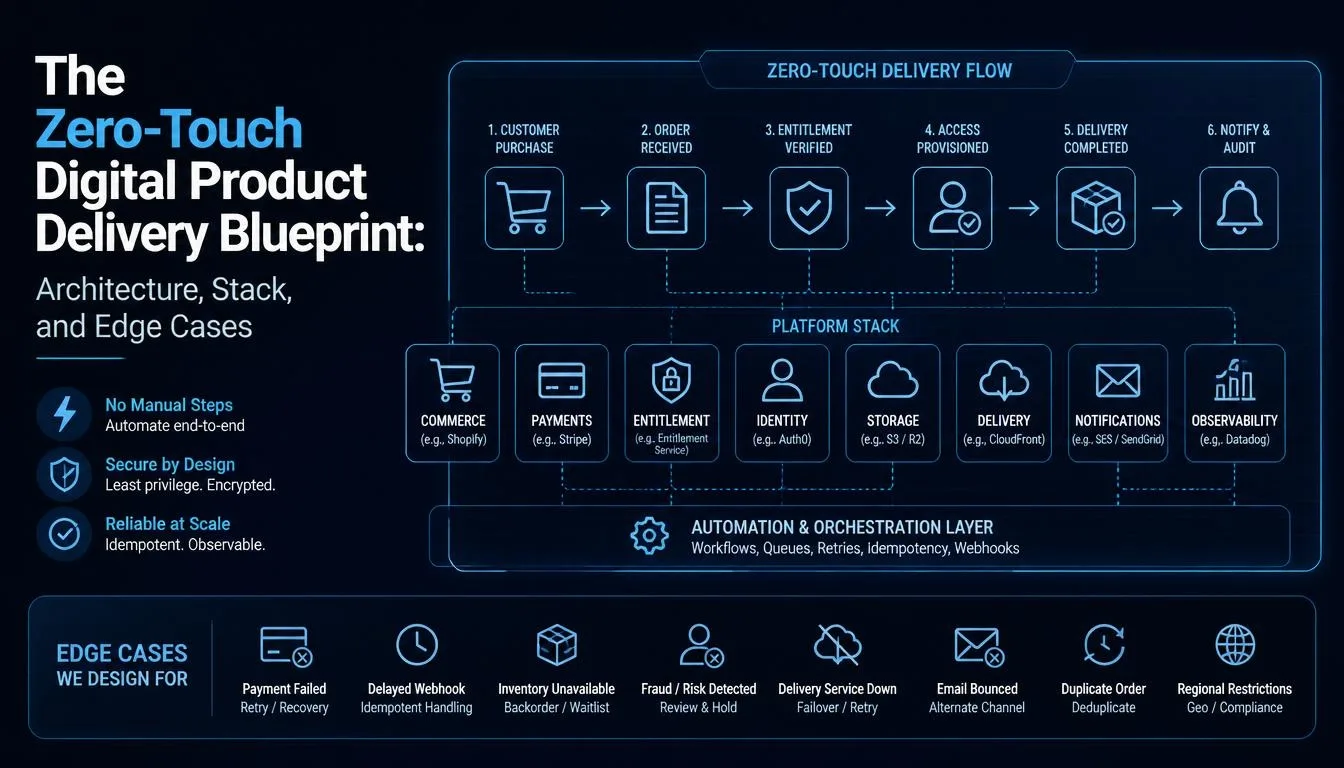
Most creators building digital product empires fail not because their product lacks value, but because their operational architecture is fragile. They launch an e-book, a cohort-based course, or a software license, and they celebrate their first sale. Then, reality sets in. A customer in Australia buys at 3:00 AM, enters their email address with a typo, and spends the next 12 hours emailing support demanding access. Another customer purchases via a legacy PayPal button that fails to trigger a redirect back to your site.
Manual delivery is a silent business killer. It drains cognitive bandwidth, introduces unnecessary friction into the buyer journey, and caps your scalability. True digital product automation goes deeper than a simple Zapier webhook connecting Stripe to Google Drive. It requires building an impenetrable, self-healing delivery pipeline that handles authorization, tokenization, dynamic watermarking, and failure recovery without human intervention.
Core Architectural Requirements for Zero-Touch FulfillmentBefore selecting software vendors, you must understand the underlying data flow of a bulletproof delivery system. Every automated transaction relies on three foundational pillars: secure webhook ingestion, identity validation, and asynchronous processing.
1. Webhook Reliability and IdempotencyYour payment gateway (Stripe, Lemon Squeezy, Paddle) acts as the source of truth. When a transaction completes, it fires a webhook to your server. Amateurs write basic listeners that assume this webhook will arrive once, perfectly, every single time. Professionals design for failure.
Network partitions happen. Stripe might retry a webhook five times if your server hiccups. Your fulfillment system must be idempotent—meaning processing the same webhook ten times yields the exact same result as processing it once (e.g., generating only one license key, sending only one welcome email). If your automation platform doesn't handle idempotency natively, you need to log transaction IDs in a database before executing fulfillment logic.
2. Identity Resolution and Access ProvisioningNever rely solely on the email address provided at checkout. Users frequently use different emails for their PayPal account, their credit card, and their actual preferred inbox. Your architecture must capture the verified checkout email, normalize it, and map it instantly to a unified user profile within your Customer Data Platform (CDP) or membership database.
The Modern Delivery Tech Stack: Comparing the ArchitecturesTo build a robust system, you must choose between an all-in-one merchant of record (MoR) or a composable, API-first stack. Let’s evaluate both approaches based on real-world engineering and revenue constraints.
The Merchant of Record (MoR) ApproachPlatforms like Lemon Squeezy, Paddle, and Gumroad act as the seller of record. They handle global sales tax compliance, VAT, invoicing, and—crucially—basic digital product delivery.
- Pros: Zero setup overhead, automated global tax liability management, built-in file hosting, and native license key generation.
- Cons: Locked into their UI and branding, higher platform fees (often 5% + transaction fees), and limited flexibility for complex custom workflows (e.g., triggering a hardware provisioning script alongside a software download).
- Best For: Solopreneurs and lean teams selling static digital assets (e.g., Notion templates, PDFs, audio packs) who want to focus entirely on marketing.
This stack stitches together best-in-class tools: Stripe for payments, Make.com or n8n for workflow orchestration, SendPost or Postmark for transactional email, and AWS S3 with CloudFront for secure asset delivery.
- Pros: Infinite scalability, complete brand ownership, lower marginal costs at scale, and the ability to integrate complex logic (e.g., generating personalized PDF certificates on the fly using APIs).
- Cons: Requires technical maintenance, monitoring API version deprecations, and building your own error-handling dashboards.
- Best For: High-volume creators, SaaS founders, and businesses selling dynamic or high-ticket digital products.
If you run an automated digital delivery system long enough, Murphy’s Law will take effect. Here are three catastrophic edge cases we have encountered in high-volume launches, along with the engineering patterns required to neutralize them.
Edge Case 1: The Bounce and Typo TrapA buyer types john@gmial.com instead of gmail.com. Your automation instantly fires a welcome email with their secure download links to a dead inbox. John never receives his product, initiates a chargeback for fraud, and trashes your sender reputation.
The Fix: Implement a double-opt-in verification step for high-value or technical digital products. Alternatively, use an API-driven email verification service (like NeverBounce or ZeroBounce) inside your checkout webhook handler. If the email returns a hard bounce or is flagged as a disposable domain, hold the fulfillment and trigger an SMS verification or a manual support ticket.
Edge Case 2: Link Scraping and PiracyYou generate a standard AWS S3 download link that expires in 7 days. A customer posts that link publicly on a forum or Reddit. Within 24 hours, thousands of leechers download your $500 video course, causing your cloud egress bandwidth bills to spike and devaluing your intellectual property.
The Fix: Never use static, long-lived URLs. Implement signed URLs via Amazon CloudFront or Google Cloud CDN that expire after 120 seconds or a maximum of two successful downloads. Furthermore, deploy dynamic user-watermarking for PDFs. When a purchase occurs, an AWS Lambda function should stamp the buyer's email and transaction hash onto the cover page of the PDF before serving the signed download link.
Edge Case 3: Chargebacks and Refund AbuseAn opportunistic buyer purchases your digital asset, downloads the files, and immediately files a chargeback with their bank claiming unauthorized use. If your automation only looks at charge.successful and never listens to charge.dispute.created, your system lets them keep the goods while you lose the revenue and pay a dispute fee.
The Fix: Build bidirectional webhooks. Your automation must listen for dispute, refund, and chargeback events. The moment a dispute is registered, a webhook must trigger a script that instantly revokes the user's license key, removes them from the membership database, and disables their download tokens.
Step-by-Step Implementation: Building a Resilient n8n Delivery PipelineLet's walk through the architecture of a production-grade webhook handler using an open-source workflow automation tool like n8n connected to Stripe and a private database.
Step 1: The Webhook Trigger NodeSet up a webhook node in n8n listening for the checkout.session.completed event from Stripe. Ensure you validate the Stripe signature header within the node configuration to prevent malicious actors from triggering unauthorized product fulfillment.
Pass the payload into a PostgreSQL node. Insert a row into a transactions table containing the stripe_session_id, customer_email, and product_id. Set a unique constraint on the session ID to enforce idempotency. If the insert fails due to a duplicate key, terminate the workflow safely.
Use a Switch node to route the workflow based on the product_id metadata sent from Stripe.
- Digital Download: Call an AWS Lambda function to generate a cryptographically signed, short-lived CloudFront URL.
- License-Based Software: Make an API call to your license management server (e.g., Keygen.sh) to generate a unique activation key.
- Community Access: Send an API request to Slack, Discord, or Circle to generate a magic invite link.
Route the generated assets, keys, or links into an API-driven email provider like Postmark or Resend. Avoid sending transactional emails through standard marketing automation platforms (like Mailchimp or ConvertKit) where deliverability can be delayed by rate limits or bulk-queue processing. Transactional emails must hit the user's inbox within five seconds of payment confirmation.
Monitoring, Logging, and ObservabilityAutomation without monitoring is a liability. You cannot afford to discover that your delivery pipeline broke three days ago because customers are emailing you in a panic.
Implement a dedicated error-handling branch in your workflow builder. If any HTTP request fails (e.g., your license generation API times out), the error handler must catch the exception, push the payload to an internal Slack channel or PagerDuty alert, and log the failure state in your database for automated retries. By shifting your mindset from "set-and-forget" to "engineering resilient systems," you turn digital product delivery into a predictable, frictionless engine for growth.
The Zero-Touch Digital Product Delivery Blueprint: Architecture, Stack, and Edge Cases
The Zero-Touch Digital Product Delivery Blueprint: Architecture, Stack, and Edge Cases