
The High-Margin Asset Play: How to Build, Price, and Scale Digital Checklists and Workbooks

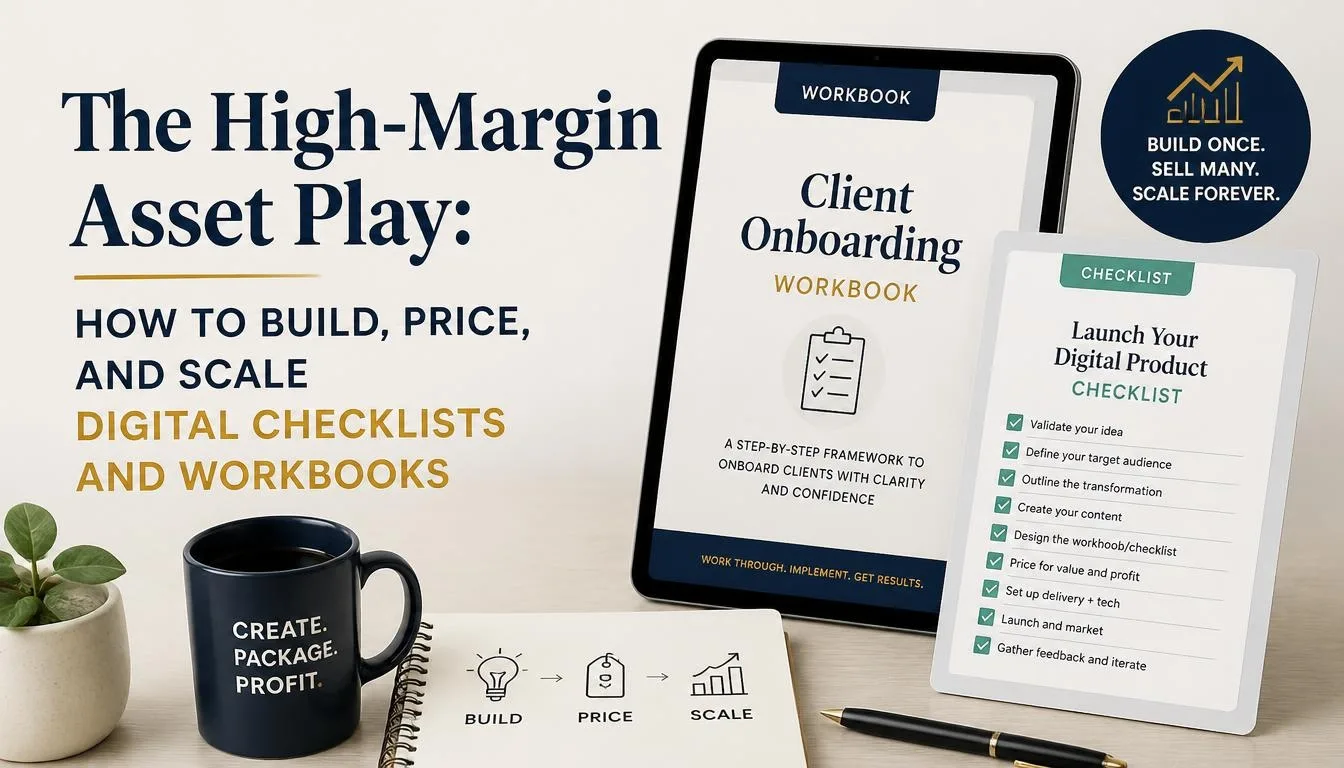
Most digital product creators fail because they treat low-ticket assets like throwaway lead magnets. They build a flimsy, 3-page PDF, slap it on a landing page, and wonder why conversions stall and revenue flatlines. Over the past decade building and scaling digital ecosystems, I’ve learned a hard truth: Checklists and workbooks are not cheap entry-level bribes; they are high-velocity cognitive accelerators. When engineered with surgical precision, a single workbook can pull in six figures while simultaneously filtering out tire-kickers and delivering immediate transformation to your buyers.
If you want to build an asset that sells consistently without requiring a massive audience, you need to abandon generalist advice and adopt an engineering mindset. Here is the exact blueprint for conceptualizing, formatting, pricing, and scaling profitable digital checklists and workbooks.
The Architecture of High-Value Cognitive AssetsBefore writing a single word, you must understand why people actually buy these assets. Buyers do not pay for information—information is free, infinite, and ubiquitous. Buyers pay for execution, compression, and order. A checklist reduces cognitive load. A workbook forces implementation. Your entire goal is to bridge the gap between abstract knowledge and tangible, real-world execution.
The 3 Core Pillars of a Sellable Workbook- Linear Friction Reduction: Eliminate every unnecessary decision the user has to make. Every page should answer one distinct question and require one specific action.
- Built-in Momentum Triggers: Include rapid early wins within the first 10 minutes of interaction to build psychological buy-in.
- Extensible Frameworks: Provide reusable modular systems rather than rigid, one-size-fits-all templates.
The days of exporting a basic Google Doc to PDF and selling it for $27 are over. Modern consumers expect interactive, beautifully designed experiences that feel premium. Whether you choose Notion, interactive PDFs, or structured physical-digital hybrids, your format must match your market's sophistication.
Unlocking 'Information Gain'To stand out in a saturated market, your workbook must contain proprietary mental models. Do not repeat standard industry definitions. Instead, document your proprietary frameworks, naming your methodologies. For example, instead of offering a generic "content marketing checklist," build the "7-Stage Omnichannel Distribution Matrix." Proprietary naming instantly elevates perceived value.
Structuring for Maximum Completion RatesIndustry data shows that the average completion rate for digital courses is roughly 15%. Workbooks can perform significantly better—often exceeding 40%—if structured correctly. Use the Action-Reflection-Iteration (ARI) model:
- Action: Give a direct, unambiguous instruction. (e.g., "List your top three revenue-generating clients from the last 12 months.")
- Reflection: Ask a targeted diagnostic question to uncover gaps. (e.g., "What operational bottleneck cost you the most time during their onboarding?")
- Iteration: Provide the corrective framework to fix the gap instantly.
Pricing is rarely a math problem; it is a positioning problem. Most creators underprice their workbooks because they anchor the value to the physical cost of paper or the time it took to type the text. This is a fatal strategic error.
You must price based on the Economic Delta—the financial or operational distance between where the buyer is right now and where your workbook takes them. If a $97 operations checklist saves a small business owner 10 hours a week or prevents a single catastrophic hiring mistake, the ROI is mathematically infinite.
The Value Staircase Pricing Model- Tier 1: The Core Asset ($47 - $97). The standalone checklist or workbook, optimized for self-guided implementation.
- Tier 2: The Implementation Suite ($197 - $297). The workbook paired with Loom video breakdowns, swipe files, or automated templates.
- Tier 3: The Interactive Ecosystem ($497+). The workbook embedded inside a private community, interactive software workspace (like a custom Notion dashboard), or paired with live office hours.
Great products do not sell themselves. You need a dedicated acquisition funnel designed to turn cold traffic into high-intent buyers without relying on expensive, complex launch cycles.
The Micro-Offer Tripwire FunnelOne of the most reliable ways to sell a workbook is through a self-liquidating tripwire funnel. Here is how it works:
- The Entry Point: A hyper-specific, high-converting lead magnet (e.g., a 1-page audit sheet).
- The One-Time Offer (OTO): Immediately upon opt-in, present a high-value workbook for $37 instead of its standard $97 price tag, available only on that page.
- The Economics: The revenue generated from the OTO completely covers your customer acquisition costs (CAC), allowing you to acquire email subscribers for free while building an immediate pool of proven buyers.
Your sales page should focus heavily on the friction points of inaction. Use specific, vivid scenarios. Do not write: "Learn how to organize your business." Instead, write: "Stop wasting three hours every Monday morning trying to figure out which client project to prioritize. Use this exact 12-step triage checklist to clear your queue by noon." Speak directly to the operational pain.
Phase 4: Scaling and Maximizing Lifetime Value (LTV)Selling a $47 workbook to 1,000 people generates $47,000—a solid milestone. But the real game begins *after* the purchase. A checklist or workbook is the ultimate diagnostic tool. It tells you exactly what your customer is struggling with next.
If a user completes your workbook on financial forecasting and struggles with the cash-flow projection section, they are now the ideal prospect for your $2,000 high-ticket consulting program or your $500 advanced masterclass. Treat your workbook not as the end of a transaction, but as the most qualified entry point into your broader ecosystem.
Iterative Optimization Based on User DataTo scale sustainably, track where users drop off inside your workbook. Use feedback loops—such as a single optional survey question on the final page—to ask: "What was the single hardest exercise in this workbook?" Use that feedback to continuously refine the asset, turning version 1.0 into an industry standard by version 3.0. When your product actually works, word-of-mouth compounding takes over, and your acquisition costs drop close to zero.
The High-Margin Asset Play: How to Build, Price, and Scale Digital Checklists and Workbooks
Discover the expert framework to build, price, and scale high-margin digital checklists and workbooks. Maximize conversion rates today.