
Why Single-Product Startups Hit a Ceiling: How to Engineer a High-Margin Product Suite

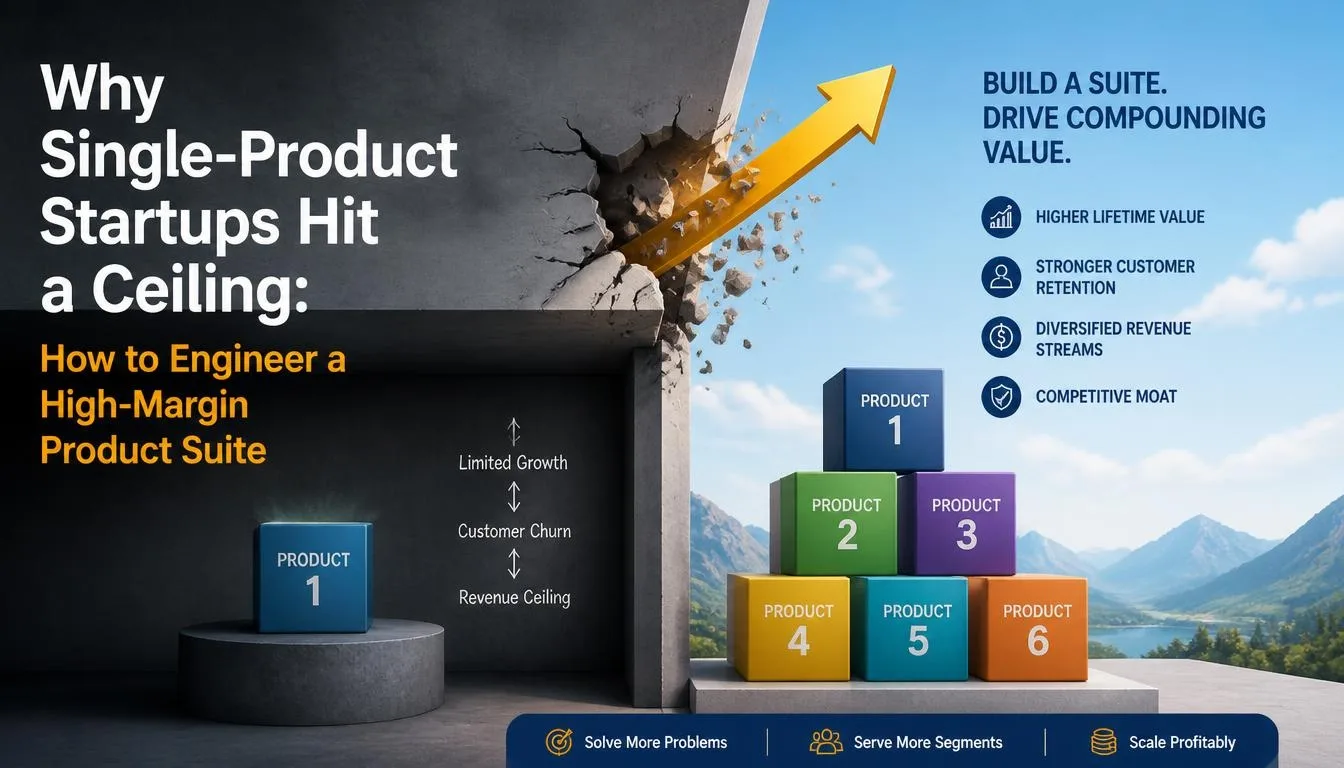
Relying on a single product is a calculated risk that eventually turns into a terminal growth ceiling. Most founders build a flagship offering, achieve initial product-market fit, and then watch their customer acquisition costs (CAC) climb while net revenue retention (NRR) stagnates. Scaling past eight figures demands a strategic pivot: moving away from a siloed product and engineering a cohesive, multi-product suite.
Having advised and scaled SaaS portfolios through multiple market cycles, I’ve seen firsthand how a well-architected product suite transforms customer lifetime value (LTV) and protects against market commoditization. Here is the operational blueprint for transitioning from a single-product company to a resilient, multi-product powerhouse.
The Economic Imperative of the Product SuiteWhen you sell a single product, your growth is shackled to net-new customer acquisition. In mature markets, this is an expensive game. Competitors chip away at your differentiation, feature parity erodes your pricing power, and your CAC-to-LTV ratio deteriorates.
A product suite alters the economic equation entirely. By introducing adjacent solutions tailored to the same buyer persona, you unlock three primary financial levers:
- Expanded Total Addressable Market (TAM): You can capture segments of your market that found your flagship product either too complex or too narrow.
- Depressed Blended CAC: Marketing to an existing customer base costs a fraction of acquiring a brand-new logo.
- Staggered Churn Mitigation: If a customer outgrows or temporarily pauses one product, they often retain their subscription to another within your ecosystem.
The biggest mistake product teams make when building a suite is chasing shiny objects—building products that sound exciting to engineering but bear no operational relevance to the core user base. Expansion must be driven by data and workflow gravity, not internal brainstorming sessions.
Analyze Adjacent Workflow FrictionMap your users' day-to-day operations from end to end. Where does your product enter their workflow, and more importantly, where do they go immediately *after* they finish using your software? That handoff point is your golden opportunity.
For example, consider a company that builds an elite email marketing automation tool. Once a campaign is sent, where does the user go? They head to a spreadsheet or a business intelligence tool to analyze conversion rates, or they scramble to build landing pages. Building a native landing page builder or an analytics layer isn't a distraction; it is capturing adjacent workflow value.
Evaluate the 'Buy vs. Build vs. Partner' MatrixBefore writing a single line of code for a new product, run a rigorous feasibility assessment:
- Core Competency Alignment: Does this new product leverage our existing technical infrastructure and domain expertise?
- Data Moat Integration: Will the new product feed data back into our core system, making the entire suite smarter and stickier?
- Time-to-Market Window: Can we build a minimum viable product (MVP) within 6 months, or has a competitor already captured the land-grab phase?
A product suite fails when the architecture feels like a Frankenstein's monster of acquisitions and disjointed codebases. Your users should feel like they are logging into an ecosystem, not juggling a collection of disparate software tools.
Unified Identity and Design SystemsIf a user has to log in with separate credentials, navigate vastly different user interfaces, and reconcile conflicting data formats between your flagship product and your new release, you have failed. Invest upfront in a shared design system and a centralized identity access management (IAM) infrastructure. Single sign-on (SSO) across the suite is non-negotiable.
Monetization Models: Bundling vs. À La CartePricing a product suite is an exercise in behavioral economics. If you bundle everything together too early, you leave money on the table for heavy power users. If you price everything separately, you introduce friction that stalls adoption.
The most successful B2B suites deploy a Core + Module architecture:
- The Anchor: The foundational product that solves the primary pain point and commands the base subscription fee.
- The Add-ons: Specialized modules priced on consumption or seat-tiers that plug directly into the anchor product.
- The Enterprise Bundle: A packaged tier that unlocks the entire suite at a volume-discounted rate, driving up average contract value (ACV).
Scaling a product suite breaks traditional organizational structures. Marketing, sales, and customer success teams must evolve from selling a point solution to orchestrating an adoption journey.
Restructuring Sales CompensationIf your account executives (AEs) are only incentivized on net-new logos for the flagship product, they will actively ignore your new product lines. Your compensation plans must heavily reward multi-product deals and expansion revenue. Make cross-selling a core KPI for both sales and customer success.
Product-Led Growth (PLG) as a Discovery EngineThe most efficient way to scale a suite is through in-app product-led cross-selling. Instead of relying on a human sales rep to pitch a secondary product, design lightweight, contextual triggers within your core product.
For instance, if a user hits a specific threshold of data processed in your core analytics tool, prompt them with a one-click trial of your advanced forecasting module. Let the product do the heavy lifting of demonstration and conversion.
Common Pitfalls That Destroy Product SuitesEven seasoned leadership teams stumble when expanding their footprint. Watch out for these critical failure modes:
- Diluting Brand Clarity: If your marketing messaging tries to appeal to every use case across five different products, you will sound generic. Keep your core positioning razor-sharp while positioning the suite as specialized horsepower for specific stages of growth.
- Starving the Core: Do not redirect 90% of your engineering resources to a speculative new product at the expense of your flagship cash cow. Balance innovation with maintenance.
- Forced Bundling Resistance: Never force customers to buy a broken or immature secondary product by bundling it inextricably with a beloved core product. Let products earn their keep through undeniable utility.The Long-Term Dividend
Transitioning from a single product to an integrated suite is admittedly complex. It requires strategic discipline, cross-functional alignment, and a willingness to cannibalize your own point-solution revenue for a larger share of your customer's wallet. However, the companies that execute this shift successfully build durable economic moats that endure market shifts, outpace nimble single-feature competitors, and command premium valuation multiples when liquidity events arrive. Build the ecosystem, not just the tool.
Why Single-Product Startups Hit a Ceiling: How to Engineer a High-Margin Product Suite
Stop relying on a single product. Discover the proven blueprint for engineering, pricing, and scaling a profitable multi-product SaaS suite.